

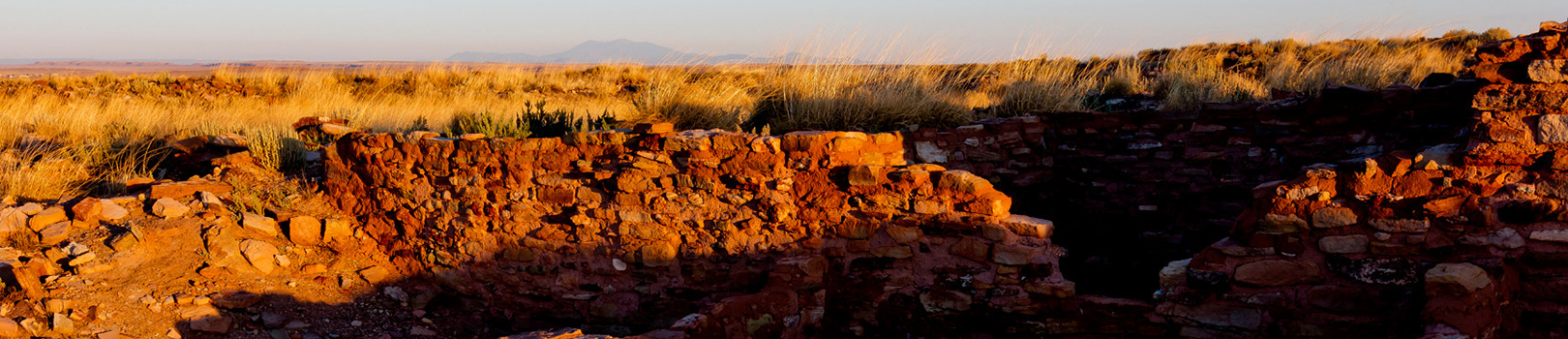
The Homolovi I pueblo site and trail is closed due to rainfall.
Note: Arizona does not observe Daylight Saving Time.
Star Party and Guest Speaker at Homolovi State Park
Homolovi State Park
2nd Saturday of the Month, April - November 7 p.m. (April-Aug.) | 6 p.m. (Sept.-Nov.)
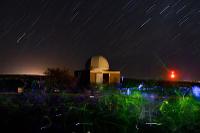
Homolovi State Park's astronomy events take place on the second Saturday of each month and are free with paid park entry. Each event features a guest speaker during the first hour; presentations are held in the park's visitor center and museum. Following the presentation, telescope viewing is available through the Winslow Homolovi Observatory's Moore Telescope (Celestron 14" Schmidt-Cassegrain). Night sky targets will be announced for the evening and may include deep space nebulae, star clusters, and more.
Thank you to the Little Colorado River Valley Astronomy Club for supporting these astronomy events. Learn more about them at www.lcrvac.org or nightsky.jpl.nasa.gov/clubs/
View the Winslow Homolovi Observatory newsletter for information on the upcoming Star Party guest speaker, as well as to preview night sky targets for telescope viewing.
- Keep Looking Up (October 2026)
- Keep Looking Up (September 2026)
- Keep Looking Up (August 2026)
- Keep Looking Up (July 2026)
- Keep Looking Up (June 2026)
Camping reservations for the night of the events can be made online at azstateparks.com or by calling (877) MY-Parks (877)-697-2757. Information about guest speakers will be updated as it becomes available.
2026 Schedule
July 11, 2026 at 7-9:30 p.m.
August 8, 2026 at 7-9:30 p.m.*
September 12, 2026 at 6-8:30 p.m.
October 10, 2026 at 6-8:30 p.m.
November 14, 2026 at 6-8:30 p.m.
*See guest speaker/program information below.
Program Information
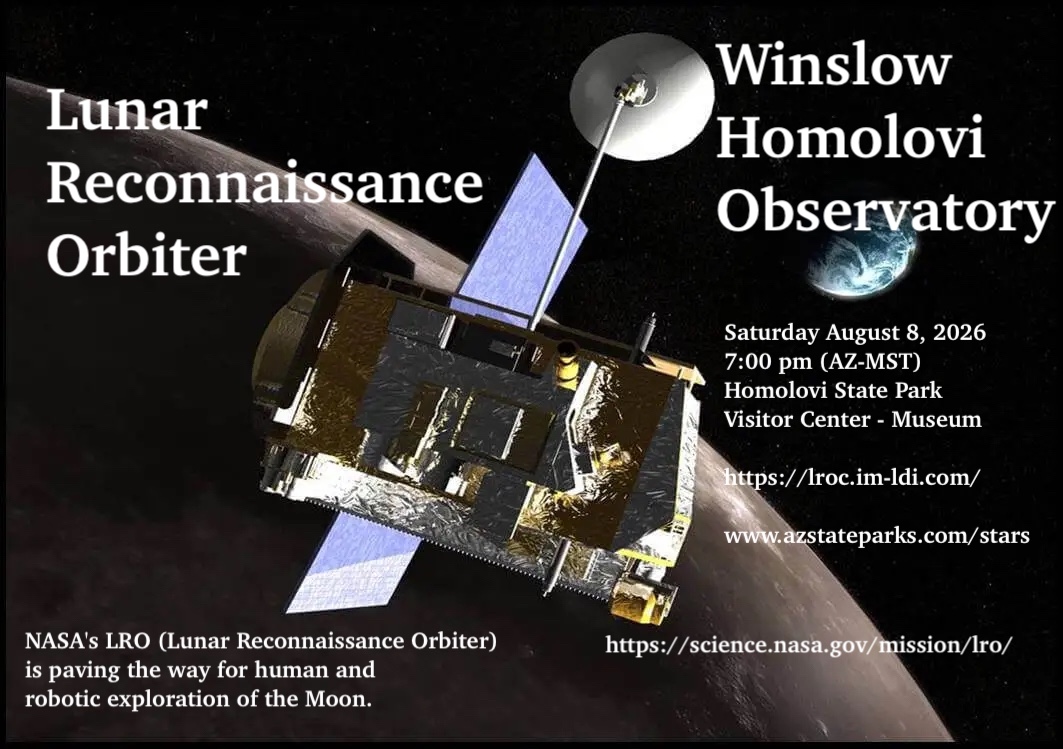
Guest Presenter — August 8
The Lunar Reconnaissance Orbiter Camera (LROC) Science Operations Center (SOC) team has been acquiring and analyzing high-resolution images of the Moon for about 17 years as part of NASA’s Lunar Reconnaissance Orbiter (LRO) mission. The team is responsible for the full data lifecycle, including capturing, calibrating, processing, archiving, and distributing observation data through NASA’s Planetary Data System.
Guest Presenter — September 12
In September, our program is "How to Land a Rover on Mars" with David Mayer. David Mayer is a Geographer at the USGS Astrogeology Science Center where he specializes in creating and analyzing topographic maps of planets and moons throughout our solar system. He also leads the planetary geodesy project team in Astrogeology and helps maintain the digital archive of images collected by NASA spacecraft from 1966 to the present. David earned a master's degree in Earth and planetary geology from Washington University in St. Louis in 2009 and a master's degree in geography from Clark University in 2013.
MORE EVENTS
-
Saturday, October 17, 2026
Tsüvó Trail and Diné Point at Homolovi
Enjoy a hike along ancient trails with a Park Ranger.
-
Sundays, Oct 18 and Nov 1
Textile production at Homolovi : A review of the cultural significance and technical introduction to weaving
Textile production at Homolovi : A review of the cultural significance and technical introduction to weaving
-
Saturdays, Oct 3, 2026 and Oct 24, 2026
Homolovi II Ancestral Hopi Pueblo Tour and Petroglyphs
Join a ranger lead hike at the Homolovi II Ancestral Hopi Pueblo. Guests will see the outline of five domestic rooms and a reconstructed ceremonial structure (kiva). The petroglyphs are located below the mesa.
-
Various Dates Between Oct 4 - Nov 15 (Oct 4 tour canceled)
Homolovi IV Pueblo Guided Tour
Join a Ranger for a tour of one the park's archaeological sites that is normally closed to the public. Registration is required for this event. This pueblo consisted of approximately 200 stone masonry rooms built in a stepwise fashion down the sides of a small butte on the west bank of the Little Colorado River. It was occupied for a short time in the mid 1200s.
-
Saturday, October 31, 2026
Homolovi II Ancestral Hopi Pueblo Tour
Take a guide walk with a Ranger to the Homolovi II pueblo. Homolovi II is the largest of the seven villages that comprise the Homolovi settlements.